

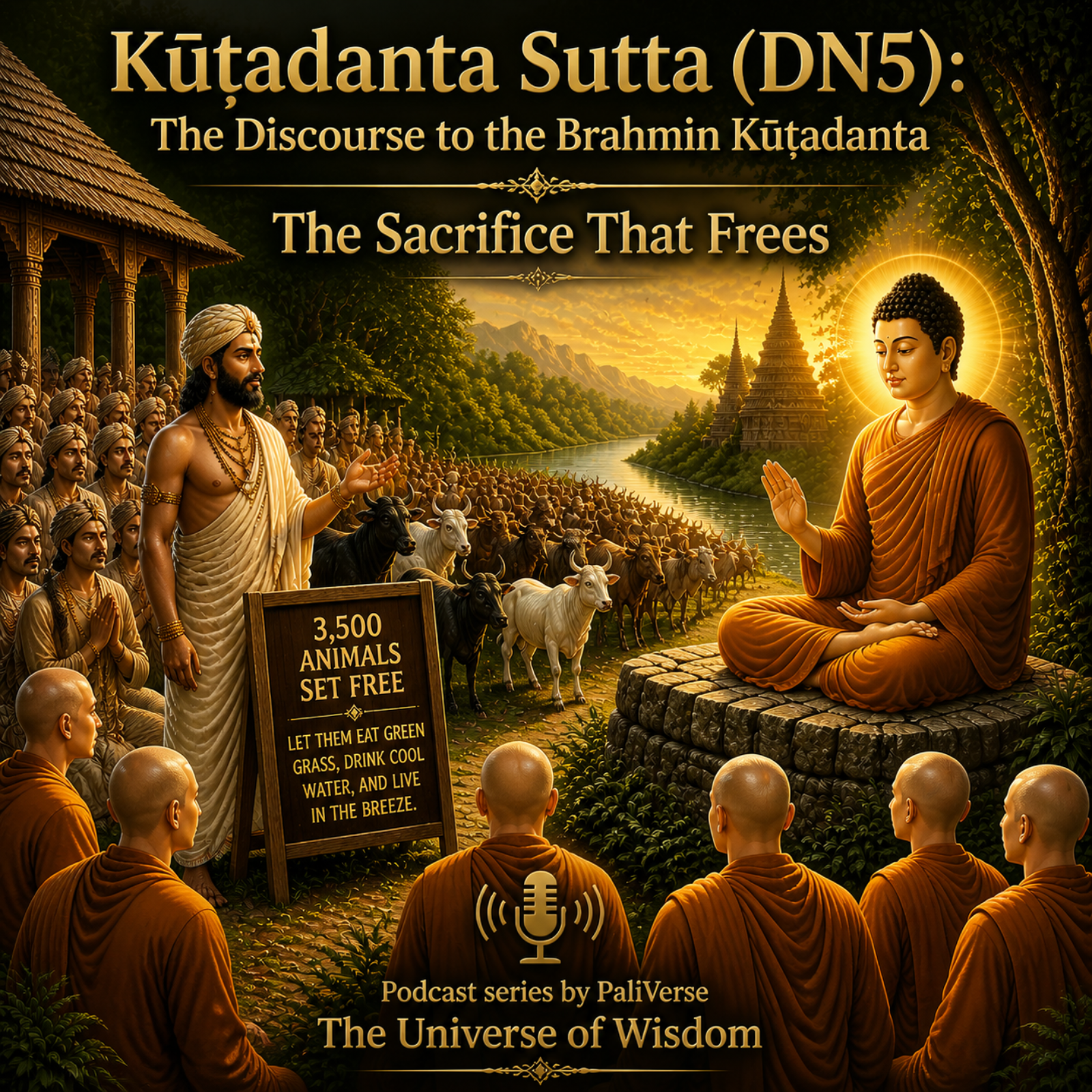
Kūṭadanta Sutta (DN5): The Discourse to the Brahmin Kūṭadanta — The Sacrifice That Frees
A wealthy brahmin named Kūṭadanta has prepared a great sacrifice. Three thousand five hundred animals stand tied to posts — seven hundred bulls, seven hundred bullocks, seven hundred heifers, seven hundred goats, and seven hundred rams — waiting for slaughter. He has heard that the ascetic Gotama knows the threefold accomplishment of sacrifice with its sixteen requisites, and he goes to ask the Buddha how best to perform what he is about to perform.
What follows is a conversation that turns the question itself inside out. The Buddha does not condemn sacrifice. He answers it — and in answering, transforms the meaning of every word in it.
In this episode, we walk through the Kūṭadanta Sutta — the fifth discourse of the Dīgha Nikāya — read in all three of its traditional layers: the root text spoken by the Buddha himself, the ancient commentary (Aṭṭhakathā), and the sub-commentary (Ṭīkā).
The Buddha’s answer to Kūṭadanta begins with a story. Once upon a time there was a king named Mahāvijita — of great wealth, who wished to perform a great sacrifice. His chaplain surprised him: do not begin with the post and the fire. Begin with the country itself. Banditry was widespread. The king’s first instinct was to crush it by force. The chaplain told him to do the opposite — give seed and food to those who farm, capital to those who trade, food and wages to those in service. Only then, when the doors of the houses stood open at night, would the country be ready for an offering.
From there the chaplain laid out the sixteen requisites — four consents the king must seek, eight qualities the king himself must possess, four qualities required of the brahmin who conducts the ceremony. And the threefold accomplishment turned out not to be three rituals, but three steady states of mind held across time: before the act, during the act, after the act. No regret. No wavering. No unfinished business in the mind of the giver.
Then the description of the sacrifice itself. No cattle were killed. No goats and sheep were killed. No trees were cut down for posts. No servants were threatened or weeping as they prepared. Those who wished to help, helped. Those who did not wish to, did not. The sacrifice was accomplished with ghee, oil, butter, curds, honey, and molasses.
Then the Buddha goes further. Is there, he asks, a sacrifice less troublesome and more fruitful than even that? There is. The perpetual gift — the smaller, repeated giving that does not end. And less troublesome still, with greater fruit? The dwelling built for any practitioner who comes seeking shelter. And greater than that? Going for refuge. And greater still? A life shaped by the five training rules. And greater again? The meditative absorptions. And at the top of the ladder, the direct knowing that ends the forward momentum into further existence altogether.
Each step quieter than the last. Each step requiring less from the world outside, and more from the world inside.
And then the moment the discourse turns from a teaching into an act. Kūṭadanta does not only acknowledge what he has heard. He sends a man to the sacrificial enclosure. Untie them. Untie all of them. I give them life. Let them eat green grass. Let them drink cool water. And let a cool breeze blow upon them.
Only after the animals walk free does the Buddha give him the teaching unique to the Buddhas. And in that very seat, the stainless eye of the Teaching opens in him.
Read the sutta in all three layers and ask your own questions at paliverse.org.
Support this work: paliverse.org/donation
Topics: Kūṭadanta Sutta (DN 5) · Dīgha Nikāya / Digha Nikaya · Pāli Canon · Theravāda Buddhism · animal sacrifice · generosity (dāna) · non-violence