

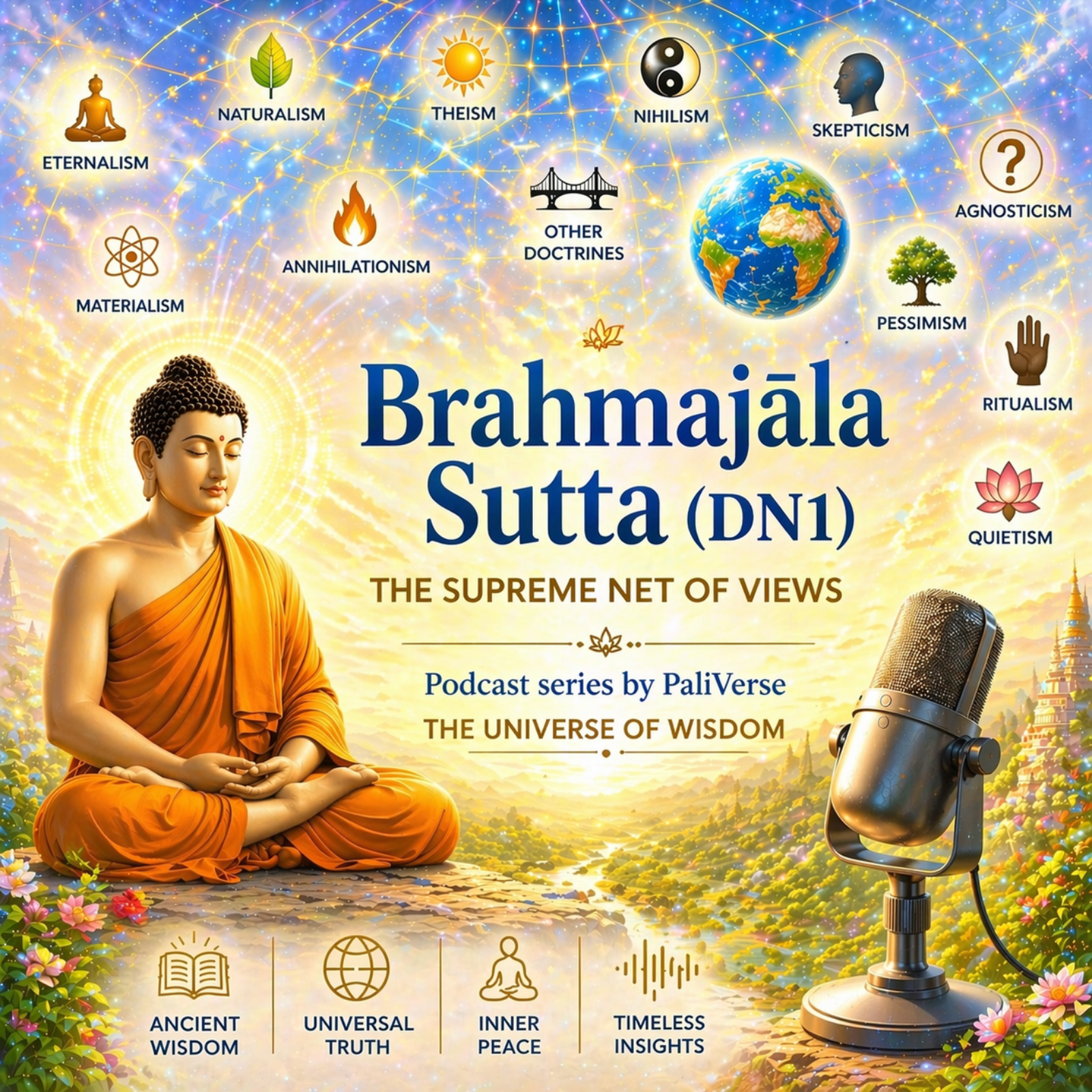
Brahmajāla Sutta (DN1): The Supreme Net of Views — An Explanation Based on the Pali Canon
The Brahmajāla Sutta, the first discourse of the Dīgha Nikāya (Long Discourses), opens with a deceptively simple scene: two travellers on the same road, following the same procession, arriving at opposite conclusions about what they see. The wanderer Suppiya disparages the Buddha throughout the journey from Rājagaha to Nālandā; his young disciple Brahmadatta praises him at every step. From this single contradiction, the Buddha draws out the central question of the entire discourse — how beliefs and views are formed, and why the same reality produces radically different convictions in different minds.
The sutta then maps sixty-two speculative positions held by the ascetics and philosophers of the Buddha’s time, covering every major theory about the self, the world, and what follows death: Eternalism, Partial Eternalism, Annihilationism, Fortuitous Origination, doctrines of conscious and non-conscious survival, and the claim that some present meditative state is itself the final liberation. The Buddha organises these into eighteen theories about the past and forty-four about the future, and — crucially — traces each one back to the specific experience from which it arose.
Many of these views, the sutta shows, were grounded not in idle speculation but in genuine meditative attainment, including the direct recollection of past lives across hundreds of thousands of cosmic aeons and the perception of the universe contracting and expanding — an image that modern cosmology would only begin to echo with Hubble’s discovery of the expanding universe in 1929.
The Buddha’s argument is not that these meditative perceptions were false. They were real. His argument is that the conclusions drawn from them exceeded what any sense faculty — including the mind, which the Pāli Canon counts as the sixth faculty alongside eye, ear, nose, tongue, and body — can warrant. Every faculty has limits, and every view formed through those faculties is conditioned by the same process: contact, feeling, craving, conviction. No view, however refined its meditative basis, escapes this process. All sixty-two are caught inside what the Buddha calls the Supreme Net — and he deliberately refuses to add a sixty-third.
In this episode, we follow the sutta’s own arc from the roadside contradiction through the Buddha’s instruction on praise and blame, past the three sections on virtue he calls “trifling,” into the heart of the sixty-two views, and finally to the closing image preserved by the tradition: the cord of becoming, cut. The episode draws on the root text as its primary source, turning to the commentary (Aṭṭhakathā) and sub-commentary (Ṭīkā) only where they deepen what the root text compresses — including the psychological motivations of Suppiya and Brahmadatta, the precise definition of contact as the meeting of faculty, object, and consciousness, the sub-commentary’s celebrated “beds making noise” simile, and the doctrinal weight folded into the sutta’s final phrase.
This is the first episode in the PaliVerse series on the Dīgha Nikāya. If the question of whether any belief can be trusted to report reality — rather than merely reflect the conditions of its own formation — is one that interests you, this discourse is where the Buddhist tradition’s inquiry into that question begins.
Read the Brahmajāla Sutta in all three of its traditional layers, and ask your own questions at paliverse.org.
Support this work: paliverse.org/donation
Topics: Brahmajāla Sutta (DN 1) · Dīgha Nikāya / Digha Nikaya · Long Discourses of the Buddha · Pāli Canon · Theravāda Buddhism · sixty-two views · eternalism and annihilationism · wrong view · dependent origination
Jāliya Sutta (DN7): The Discourse to the Wanderer Jāliya — The Question the Path Dissolves
Two wanderers come to the Buddha with a forced choice: is the soul the same as the body, or is the soul one thing and the body another? They want him to pick a side. He refuses both — and instead lays out a path…
Mahāli Sutta (DN6): The Discourse to the Nobleman Mahāli — What the Holy Life is Actually For
In Vesālī, a Licchavi nobleman named Mahāli arrives at the Pinnacled Hall with a puzzle. A man called Sunakkhatta, who had spent three years training near the Buddha, told him something strange. He could see divine forms — the visible bodies of beings on subtler…
Soṇadaṇḍa Sutta (DN4): The Discourse to Soṇadaṇḍa — Morality and Wisdom Alone Make the Brahmin
A brahmin with every credential the ancient world could offer — pure birth, Vedic mastery, beauty, wealth, royal patronage — is led step by step to strip them all away. What remains changes everything.The Soṇadaṇḍa Sutta is one of the most elegant philosophical dialogues in…