

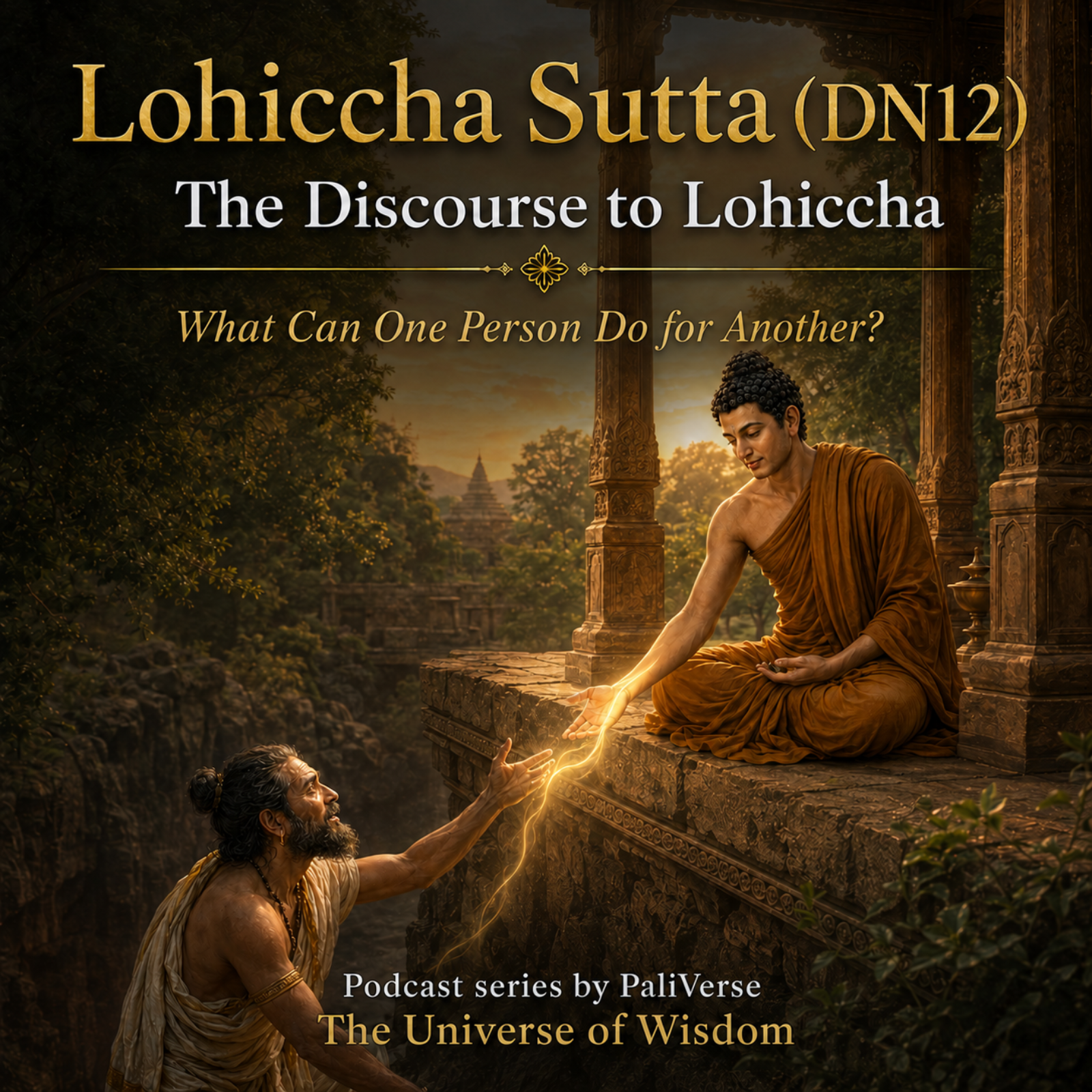
Lohiccha Sutta (DN12): The Discourse to Lohiccha — What Can One Person Do for Another?
If you discovered something that genuinely transformed your mind—something that made you calmer, wiser, and freer—should you share it with others? Or should you keep it entirely to yourself?
The brahmin Lohiccha believed that anyone who attained a wholesome state should tell no one. What can one person possibly do for another? Teaching, he argued, merely creates a new bondage after the old one has been cut. But when the Buddha arrives in Lohiccha’s village, he does not answer this belief with a sermon. He uses Lohiccha’s own wealth, his own village, and his own king to lead him through a chain of questions—until Lohiccha himself is forced to recognise what lies beneath his view. Withholding what is good is not detachment. When it obstructs the welfare of others, it is hostility.
Then the discourse turns to a more uncomfortable question: when does a teacher deserve blame? The Buddha describes three kinds of teachers who fail. One has not reached the goal, and his disciples refuse to listen. Another has not reached the goal, although his disciples follow him. A third has reached the goal, but his disciples turn away. Three possibilities are examined—and one is deliberately left unspoken. Lohiccha must ask about it himself: is there any teacher in the world who is beyond accusation?
The Buddha’s answer presents the fourth possibility: a teacher who has completed his own work and whose disciples, by listening and practising, attain the fruits of the path for themselves. The discourse therefore answers both sides of its central question. A teacher cannot practise for another person—but through right teaching, one person can show another the way. The hearer must still listen, apply the mind, and walk the path.
Lohiccha finally describes what has happened to him in unforgettable words. He was like a man falling into a hellish precipice who was seized, pulled upward, and placed on firm ground. The ancient commentary explains the image precisely: the hand that pulled him to safety was the Teaching itself.
This episode also explores the commentaries’ deeper explanations: why Lohiccha’s opinion was considered evil, how repeated wrong view becomes firmly fixed, who the “divine embryos” were, why the Buddha initially concealed the fourth kind of teacher, and what separates a blameworthy teacher from one who rightly guides others toward liberation.
Read the Lohiccha Sutta (DN12) in all three traditional layers—the canonical text, commentary, and sub-commentary—and ask your own questions at paliverse.org.
Support this work: paliverse.org/donation
Topics: Lohiccha Sutta (DN 12) · Dīgha Nikāya / Digha Nikaya · Long Discourses of the Buddha · Pāli Canon · Theravāda Buddhism · sharing the Dhamma · what makes a good teacher · wrong view · compassion and teaching

Tevijja Sutta (DN13): The Discourse on the Threefold Knowledge — The Path to the Company of Brahmā
Can anyone show you the way to a place they have never seen?Two young brahmins, Vāseṭṭha and Bhāradvāja, come to the Buddha with a quarrel: each says that his own teacher has declared the only straight path to the company of Brahmā. The Buddha does…
Kevaṭṭa Sutta (DN11): The Discourse to Kevaṭṭa — The Wonder of Instruction
If you saw a man rise into the air, pass through a wall, and touch the sun with his hand — would you believe his teaching? Be honest. Most of us would.That is exactly what a rich young householder was counting on when he came…
Subha Sutta (DN10): The Discourse to Subha — There is Still More to Be Done
The Buddha has died, and his passing is recent. A young brahmin named Subha, in the city on business, sends word to Ānanda — the attendant who stayed closest to the Teacher through his life — and asks to see him. When Ānanda comes, Subha…